Table of Content
- I decided to start over. From the very beginning!
- Art and Storytelling fundamental books
- Important note:
- Roadmap Progress Tracker
- 1. Core drawing skills
- 2. Color Theory
- 3. Fabric, Material, Texture and Surface Rendering
- 4. Composition for Visual Storytelling
- 5. Worldbuilding and Story development
- 6. Anatomy and Character Designing
- 7. Animal and Creature Design
- 8. Comic Script
- 9. Advanced Integration
- 10. Meta-Skills
- Changelog
After five years of drawing characters and illustrations for D&D players, I decided to step out of my comfort zone and build My roadmap to creating a Graphic Novel from scratch: a structured plan to study art and storytelling fundamentals to finally bring to life a fantasy story that’s been in my head since 2015.
I’ve always known that my art and storytelling skills weren’t enough to actually carry a whole graphic novel from start to finish. That I need to level up my skills to build the world, design the characters, write the story outline and comic script, and only then start drawing panels.
So I built this roadmap to systematically master drawing, design, and storytelling from the ground up.
This is a guide to studying art and storytelling fundamentals to build the skills I need to create a graphic novel from scratch.
I decided to start over. From the very beginning!
Like many self-taught artists, I’ve been learning in fragments… picking up pieces of knowledge from the internet here and there, without ever following a real, structured learning path. Over the years, my art and storytelling fundamentals ended up patchworked together instead of being a solid foundation.
I decided to learn… or perhaps relearn, art and storytelling fundamentals in a structured, cohesive way. And hopefully, become confident enough to bring this project to life.
So with my roadmap to creating a graphic novel, I’m planning to study from the beginning, rebuilding my foundation, and applying it directly into my graphic novel project.
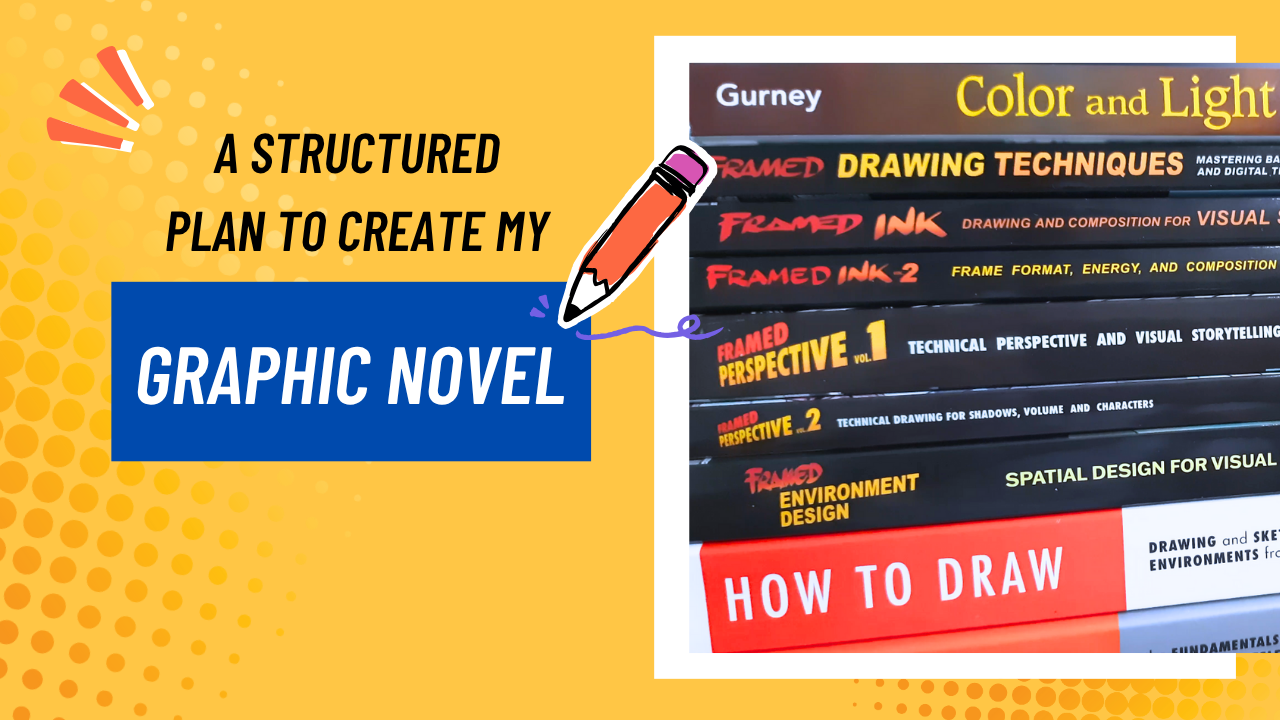
Art and Storytelling fundamental books
Over the past years, I’ve been collecting books that I kept seeing recommended by many artists.
Below, you’ll find the essential areas of study and the fundamental books that will be my personal guide on this journey.
I’ve rushed through some of these books before, just skimming when I needed something for a project. But this time, I’ve organized them along my roadmap to creating a graphic novel, and I really wanna dive into the exercises and study them properly.
Important note:
This roadmap isn’t set in stone! Think of it as a flexible guide that evolves as I progress. I’ll keep updating and reorganizing the books and content as I move through each stage, so feel free to check back from time to time for new additions or changes.
It’s also worth noting that I won’t always study a book straight through. Some books appear in more than one list because I’ll move between them, studying specific chapters that fit the topic I’m focusing on, and then return to the rest later.
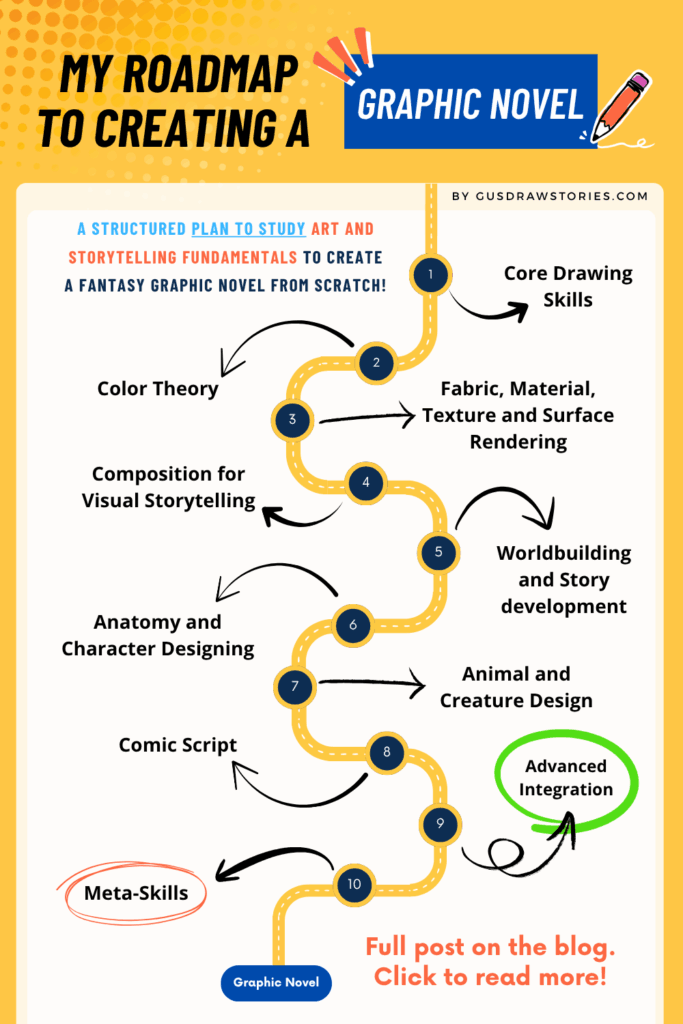
The order of these 10 stages is the best way I found for myself to level up my art and storytelling fundamentals from basic to advanced, while developing my graphic novel along the way.
It starts by building a solid foundation, then moves into more complex areas like color theory, composition, worldbuilding and story development, character designing, and finally writing a script to integrate all the fundamentals into the graphic novel creation.
Feel free to follow along with me through my roadmap to creating a graphic novel, and to share your progress. I’d love to see how you develop your art and storytelling fundamentals and how you create your own comic book, manga, webtoon or graphic novel.
But if this order don’t fit into the way you learn, you can always change the order of the books to whatever feels right for you.
Alright… without further ado, let’s dive into my roadmap to creating a graphic novel from scratch.
Roadmap Progress Tracker
1. Core drawing skills
Before diving into advanced concepts, I need to make sure my basics are solid.
I’m going back to the basics to build a solid foundation and develop my skills layer by layer.
Because I believe that by developing the understanding of the topics below, I’ll be capable of designing anything from imagination based on this foundational skills, and not only depending on intuition.
- Line quality & control (weight, rhythm, gesture)
- Perspective (1, 2, 3-point, atmospheric, curvilinear)
- Understanding 3D primitives (cube, sphere, cylinder, cone)
- Structural drawing (breaking down objects into simple 3D forms)
- Proportion & measurement (sight-size, comparative measurement)
- Overlap, foreshortening, depth cues
- Spatial relationships (scale, proportion, and rotation in space)
- Constructive drawing (building complex objects from forms)
- Light logic (light source, form shadows, cast shadows)
- Core shadow, reflected light, halftones, highlights
- Value scales (from light to dark, controlling transitions)
- Rendering basic forms (sphere, cube, cylinder, cone in light)
- Chiaroscuro (high contrast lighting for drama)
- Positive & negative space
- Atmospheric perspective (value shifts with depth)
- Contour drawing (blind contour, cross contour)
- Gesture drawing (capturing movement & flow)
Books
- Framed Drawing Techniques – Marcos Mateu-Mestre ✅
- Perspective Made Easy – Ernest R. Norling ✅
- Creative Illustration – Andrew Loomis (
Part 1: Line; Part 2: Tone) ⏸️ - How to Draw Comics the Marvel Way – Stan Lee, John Buscema (Chapters 2 and 3) ✅
- Art Fundamentals 2nd Edition: Light, Shape, Color, Perspective, Depth, Composition & Anatomy – 3d Total (Light and Shape, p.8;
Perspectiveand Depth, p.132) ⏸️ - Framed Perspective Vol. 1: Technical Perspective and Visual Storytelling – Marco Mateu-mestre – READING NOW!
- Framed Perspective Vol. 2: Technical Drawing for Shadows, Volume, and Characters – Marco Mateu-mestre (Chapter 1: Shadows on Objects)
- How to Draw: Drawing and Sketching Objects and Environments from Your Imagination – Thomas Bertling, Scott Robertson
- Color and Light: A Guide for the Realist Painter – James Gurney (Chapters 1, 2 and 3)
- Imaginative Realism: How to Paint What Doesn’t Exist – James Gurney
- How to Render: The Fundamentals of Light, Shadow and Reflectivity – Thomas Bertling, Scott Robertson
- Art Fundamentals: Theory in practice, How to critique and improve your art for better results – 3dTotal
2. Color Theory
When I’m confident enough with the core drawing skill, I can move onto Color Theory.
This is a big one for me… Color Theory has been my nemesis ever since I started drawing and I’ve never faced it head-on to master it.
So here’s where I’ll dive into everything about color, to finally feel confident enough to use color with purpose, not just intuition.
- Color wheel (primary, secondary, tertiary)
- Color properties (hue, saturation, value)
- Warm/cool colors dynamics
- Color harmonies & schemes (complementary, analogous, triadic, split-complementary)
- Local color vs light/color interaction
- Limited palettes (mastery through restriction)
- Color psychology, symbolism, mood & storytelling through palettes
- Cinematic Lighting & Color – mood-driven palettes, narrative use of light.
Books
- Creative Illustration – Andrew Loomis (Part 3: Color)
- Color and Light: A Guide for the Realist Painter – James Gurney
- Art Fundamentals 2nd Edition: Light, Shape, Color, Perspective, Depth, Composition & Anatomy – 3d Total (Color, p.52; Perspective and Depth, p.132)
- Artists’ Master Series: Color and Light – 3dtotal
- Imaginative Realism: How to Paint What Doesn’t Exist – James Gurney
3. Fabric, Material, Texture and Surface Rendering
Over the past few years, I’ve been focused on developing my art style, and what I like the most is semi-realism.
Even though comics usually lean toward a simplified or stylized “cartoony” look, for my graphic novel I’m thinking of going with a semi-realistic style, maybe with a touch of stylization, but definitely something more rendered.
To do that, I need to get comfortable with rendering. So this stage of my roadmap to creating a graphic novel is dedicated to studying everything I need to know about it.
- Drapery types (pipe, spiral, zig-zag, diaper folds)
- Rendering materials (metal, glass, wood, fabric, skin, stone, fur, hair)
- Texture vs detail (suggestion vs over-rendering)
- Surface reflection, transparency, and subsurface scattering
Books
- Framed Perspective Vol. 2: Technical Drawing for Shadows, Volume, and Characters – Marco Mateu-mestre (Chapter 4: Clothing the characters; Chapter 5: Rendering – Thought, process and execution)
- Color and Light: A Guide for the Realist Painter – James Gurney (Chapter 9: Surfaces and Effects)
- How to Render: The Fundamentals of Light, Shadow and Reflectivity – Thomas Bertling, Scott Robertson
4. Composition for Visual Storytelling
Comics are storytelling through composition, so this stage ties directly into paneling and page flow.
Here, I’ll study the core fundamentals of composition, from basics to more advanced topics.
- Rule of thirds, golden ratio, dynamic symmetry
- Focal points & visual hierarchy
- Rhythm & movement in composition
- Balance (symmetry, asymmetry, radial, tension)
- Negative space as design element
- Shape language (organic vs geometric, symbolic meaning)
- Contrast (value, color, shape, texture)
- Visual storytelling through staging
- Atmospheric & color perspective (how air changes things with distance)
- Scale and depth proportion in space
- Staging & clarity (what the viewer sees first)
- Visual symbols & semiotics
- Cinematic framing & shot language (shot types, camera angles, perspective choice)
- Sequential art basics (panel flow, beats, pacing, rhythm & page composition)
- Storytelling through contrast and continuity
Books
- How to Draw Comics the Marvel Way – Stan Lee, John Buscema (Chapter 9)
- Creative Illustration – Andrew Loomis (Part 4: Telling the Story)
- Art Fundamentals 2nd Edition: Light, Shape, Color, Perspective, Depth, Composition & Anatomy – 3d Total (Composition, p.90)
- Artists’ Master Series: Composition & Narrative – 3dtotal
- Framed Ink Vol.1: Drawing and composition for visual storytellers – Marco Mateu-mestre
- Framed Ink Vol.2: Frame format, Energy and Composition for Visual Storytellers – Marco Mateu-mestre
- Framed Perspective Vol. 2: Technical Drawing for Shadows, Volume, and Characters – Marco Mateu-mestre (Chapter 6: Notes on composition)
5. Worldbuilding and Story development
At this point, I’ll already have a clear understanding of the core drawing skills, color theory, rendering, and composition fundamentals.
So here, it starts to get a lot more exciting, because I’m gonna start shaping the world of my graphic novel, from physical aspects to magic, politics and daily life of the people who lives in it.
I’ll put into advanced practice what I learned in the previous stages, by drawing buildings, landscapes, interiors, natural settings and using them not just as backgrounds but as part of storytelling.
- Worldbuilding basics (physical and historical features, culture, religion…)
- Fantasy map making fundamentals
- Architecture (structural drawing, man-made structures, interiors, props)
- Advanced perspective (multi-point, fish-eye, inclined planes)
- Natural environments (trees, rocks, mountains, water, skies, clouds)
- Interior & exterior design (space composition and lighting)
- Prop Design
- Storytelling in environment
- Style and visual identity development (graphic design principals, personality)
- Story structure and outline
Books
- Framed Environment Design: Spatial design for visual storytellers – Marco Mateu-mestre
- How to Draw: Drawing and Sketching Objects and Environments from Your Imagination – Thomas Bertling, Scott Robertson
- Save the Cat! Writes a Novel: The Last Book on Novel Writing You’ll Ever Need.
6. Anatomy and Character Designing
When I get to this point, the world is already built, so it’s time to start populating it.
People now have places to live, and the story finally has settings where everything can unfold. So next, I’ll focus on designing the characters, from their backstories to model sheets and splash art.
Anatomy is the art fundamental I’ve studied the most, I love drawing characters. What I need to work on now are more dynamic poses, gestures, and facial expressions.
I’ve mostly been drawing the standard D&D-style character portraits, the regular standing still or predictable poses. It’s time to break out of that comfort zone.
- Gesture & action lines (flow, weight, rhythm, construction balance)
- Proportion systems (Loomis, head units, classical canon of proportions)
- Skeleton structure and landmarks (bones & joints)
- Major muscle groups, their surface, functions, how they flex and overlap
- Hands, feet, head, facial/body expressions (the hardest essentials)
- Foreshortening & dynamic poses
- Stylization & simplification of anatomy for character design
- Dynamic poses, Character posing & acting (gesture + emotion)
- Character Design Mastery – shape language, appeal, personality through design.
- Character design sheet and presentation
- Character splash art
Books
- How to Draw Comics the Marvel Way – Stan Lee, John Buscema (Chapters 4, 5, 6, 7 and 8)
- Anatomy for Artists: Drawing Form & Pose: The Ultimate Guide to Drawing Anatomy in Perspective and Pose – Tomfoxdraws
- Art Fundamentals 2nd Edition: Light, Shape, Color, Perspective, Depth, Composition & Anatomy – 3d Total (Anatomy, p.174)
- Framed Perspective Vol. 2: Technical Drawing for Shadows, Volume, and Characters – Marco Mateu-mestre (Chapter 2: Characters in Perspective; Chapter 3: Shadows on Characters)
- The Silver Way: Techniques, Tips, and Tutorials for Effective Character Design – Stephen Silver
- Imaginative Realism: How to Paint What Doesn’t Exist – James Gurney
- Sketching from the Imagination: Characters – 3dTotal (for inspiration and observation)
7. Animal and Creature Design
With the understanding of human anatomy, it’ll be a lot simpler to study animal anatomy, and then I can simplify it into forms to create believable creatures by combining different anatomies.
- Comparative anatomy (quadrupeds, birds, reptiles, insects, fish)
- Simplification into 3D forms
- Creature design (combining anatomies logically)
- Function-driven design (believability through anatomy)
Books*
*I don’t have a book on animal anatomy yet, but I’ll add one here as soon as I do.
8. Comic Script
When I get to this stage, I’ll have a world where a story unfolds and characters that are part of it. So it will be time to learn about comic script, and actually write it.
- Fundamentals of script writing for comics
Books
- Understanding Comics: The Invisible Art – Scott McCloud
- Making Comics: Storytelling Secrets of Comics, Manga and Graphic Novels – Scott McCloud
9. Advanced Integration
This is where the fundamentals finally meet comics directly.
It’s the stage where everything comes together. All the fundamentals merge into personal expression.
This is when I’ll finally feel ready to create my graphic novel, confident that I have both the technical foundation to know what I’m doing and a complete script to bring to life.
10. Meta-Skills
Learning all these art and storytelling fundamentals isn’t enough. Right from the start, I need to keep in mind that I also have to develop the meta-skills.
The thing about these is, they’re not just a topic I’ll study at the end. They’re skills I need to be developing and thinking about the whole way through the roadmap.
These are often-forgotten abilities that we artists must develop, skills that keep an artist moving forward in the long run.
- Master studies (breaking down New and Old Masters’ techniques and problem-solving)
- Visual Memory Training: drawing from memory and imagination (study, recall, correct, and refine)
- Inventing worlds (characters, props, environments)
- Creative synthesis (combining all fundamentals naturally)
- Intentional design choices (everything supports story & emotion)
- Design Thinking: not just “copy reality” but “decide what to show and why”
- Efficiency and Speed: thumbnails, fast ideation, visual shorthand
- Critical Analysis: self-critique and analytical breakdown of art
- Discipline and Workflow: practice systems, project-based learning.
- Creative Problem-Solving: pushing beyond references.
- Iterative design (thumbnailing, variation, experimentation: finding unique solutions)
This is my roadmap to creating a graphic novel from scratch: 10 stages that build on each other, starting with the basics, moving into more advanced concepts, and finally bringing everything together through storytelling.
I hope this roadmap inspires and helps anyone who wants to become a visual storyteller, whether you’re creating stories for yourself or aiming to kickstart a career in comics and graphic novels.
Make sure to check back from time to time for updates. As I mentioned earlier, this roadmap will evolve as I keep learning and progressing.
Thanks for reading!
If you’d like to follow along, subscribe to my YouTube channel! I’ll be sharing my art and storytelling studies, the ups and downs of the process, book reviews, and more.
And if you enjoy seeing my progress and want to help me keep documenting it, consider supporting me on Ko-fi. Every bit of support really helps and means a lot.
Changelog
- Dec 30, 2025: added How to Draw Comics the Marvel Way to the list, organized the chapters for Stages 1, 4 and 6, and updated the current reading.
- Jan 4, 2026: finished “Part 1: Line” from Creative Illustration, I’ll come back to Part 2 later when I start studying Values. Updated the current reading.
- Jan 9, 2026: I finished reading the perspective part from Art Fundamentals 2nd Edition, and started reading Framed Perspective Vol. 1.
